
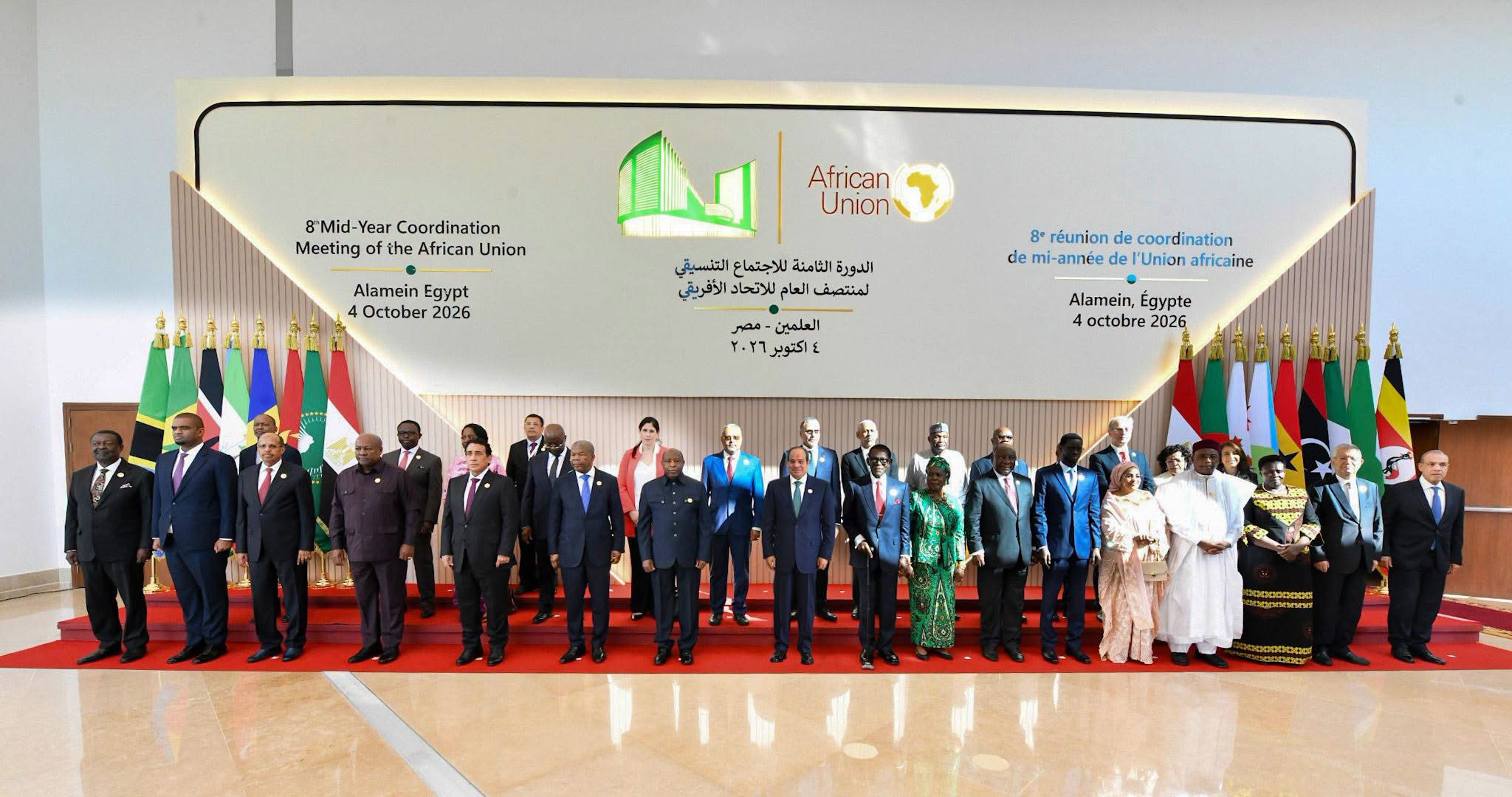
African leaders have renewed their commitment to accelerating continental integration, strengthening regional cooperation and advancing Agenda 2063 following the conclusion of the Eighth African Union (AU) Mid-Year Coordination Meeting (MYCM) on 4 October 2026 in El-Alamein, Arab Republic of Egypt.
Hosted by Egyptian President H.E. Abdel Fattah El-Sisi, the meeting brought together Heads of State and Government, leaders of the African Union Commission, Chairpersons and representatives of Regional Economic Communities (RECs), Regional Mechanisms (RMs), AU institutions and partner organisations to review progress on Africa's integration agenda and strengthen continental-regional coordination.
In his opening remarks, President El-Sisi called for closer cooperation between the AU, RECs and RMs to advance peace, economic development and regional integration. He urged African countries to expand manufacturing, develop regional value chains, promote technology transfer and increase intra-African trade to drive economic transformation.
African Union Commission Chairperson H.E. Mahmoud Ali Youssouf described the meeting as an important platform for improving policy coherence and institutional coordination. He emphasised the need to translate integration commitments into measurable results through a clearer division of responsibilities among the AU, RECs and RMs.
AU Chairperson and President of Burundi, H.E. Évariste Ndayishimiye, highlighted limited productive capacity, infrastructure gaps, inadequate financing, insecurity and water-related challenges as key barriers to integration. He called for greater investment in manufacturing, infrastructure and technology to maximise the benefits of the African Continental Free Trade Area (AfCFTA).
Leaders reaffirmed that continental integration remains central to achieving Agenda 2063 and its Second Ten-Year Implementation Plan. They stressed the need for stronger cooperation among the AU, RECs, RMs and Member States and accelerated implementation of agreed continental frameworks.
The meeting reviewed progress in implementing the AfCFTA, welcoming advances in preferential trade arrangements while calling for further action to remove non-tariff barriers, improve trade facilitation, strengthen cross-border payment systems and promote regional value chains.
Discussions also focused on industrialisation, with leaders emphasising the need to expand Africa's productive capacity, leverage natural resources and human capital, and create jobs through value addition and manufacturing.
Recognising the importance of connectivity, the meeting called for increased investment in transport corridors, energy networks, digital infrastructure and the operationalisation of the Single African Air Transport Market to support trade and regional integration.
On water and sanitation, leaders reaffirmed their commitment to the AU's 2026 theme, "Assuring Sustainable Water Availability and Safe Sanitation Systems to Achieve the Goals of Agenda 2063." They called for improved water governance, climate-resilient management and stronger transboundary cooperation.
Peace and security remained a key priority, with leaders underscoring the importance of conflict prevention, preventive diplomacy, early warning systems and closer cooperation between Regional Mechanisms and AU peace and security institutions.
Representing the Southern African Development Community (SADC), SADC Chairperson and President of the Republic of South Africa H.E Cyril Ramaphosa reaffirmed the region's commitment to peace, stability and economic transformation. He highlighted SADC's support for peacebuilding efforts in the eastern Democratic Republic of Congo, political dialogue in Madagascar and reconciliation initiatives in Mozambique. He also reiterated SADC's commitment to AfCFTA implementation, regional value chains and value addition to Africa's mineral resources.
The meeting recognised the role of the African Development Bank and other African financial institutions in financing Agenda 2063, infrastructure development, industrialisation and AfCFTA implementation. Member States were encouraged to advance the ratification of legal instruments establishing African Financial Institutions.
The meeting also reviewed progress on the division of labour among the AU, RECs, RMs and Member States, reaffirming the principles of subsidiarity, complementarity and comparative advantage as critical to effective continental governance.
In addition, the meeting welcomed the adoption by the United Nations General Assembly of Resolution A/80/L.104, "Correct the Map: Rebalancing Global Cartographic Representation and Promoting Equitable Representation of the World's Regions, Particularly Africa," describing it as a positive step towards addressing historical distortions in the representation of Africa.
The meeting concluded with the adoption of its Declaration, reaffirming the commitment of the AU, RECs, RMs and Member States to advancing continental integration, strengthening institutional coordination and promoting sustainable development, peace and prosperity across Africa.


