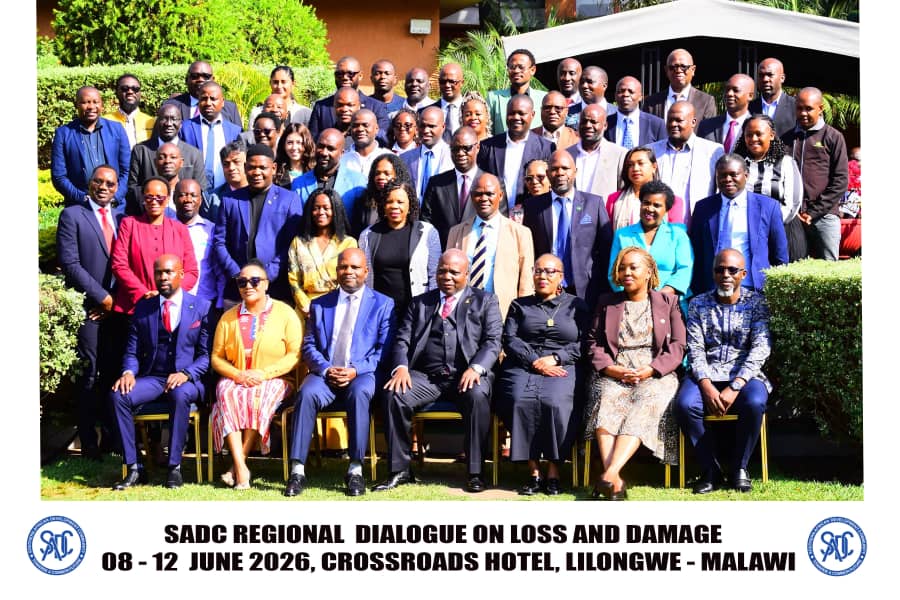
The Southern African Development Community (SADC), with support from the World Bank-funded Regional Climate Resilience Project (RCRP), has convened the SADC Regional Dialogue on Loss and Damage in Lilongwe, Malawi from 08-12 June 2026, bringing together senior government officials, international financial institutions, United Nations agencies and development partners to develop a SADC Regional Position on Loss and Damage.
The Dialogue comes at a critical time for Southern Africa. The region continues to experience increasingly frequent and severe droughts, floods and tropical cyclones that are reversing development gains, placing growing pressure on public finances and threatening the livelihoods of millions of people. These climate shocks are becoming increasingly systemic and transboundary, creating a regional polycrisis that combines climate risks with food insecurity, economic instability and displacement.
Agriculture, the backbone of Southern Africa's economies and livelihoods has emerged as the sector most affected by climate impacts, accounting for 44 to 71 percent of total disaster damages across the region. Recent disasters, including Cyclones Idai, Ana, Gombe and Freddy, have generated recovery needs amounting to billions of dollars, while back-to-back disasters continue to widen the financing gap for response and resilient recovery.
Over the past decade, SADC has made significant progress in strengthening regional disaster preparedness and response through the implementation of the SADC Disaster Risk Management Strategy and Action Plan. Key milestones include the establishment and operationalization of the SADC Humanitarian and Emergency Operations Centre (SHOC) as the regional coordination mechanism for disaster preparedness and emergency response, and the SADC Emergency Response Team (ERT) to provide rapid regional surge capacity during emergencies. Together with strengthened regional early warning systems and disaster information management, these initiatives have significantly improved the region's preparedness.
However, preparedness alone is no longer sufficient. While the region has strengthened its capacity to anticipate and respond to disasters, financing for recovery has not kept pace with the increasing scale and frequency of climate impacts. Recovery continues to rely heavily on humanitarian appeals and emergency budget reallocations, creating growing recovery deficits that undermine long-term resilience.
The Dialogue therefore marks an important shift in SADC's resilience agenda from strengthening preparedness to building recovery readiness.
It builds directly on the recently approved SADC Regional Disaster Recovery Framework (2026–2030), which provides the region's common framework for resilient recovery. The development of the SADC Regional Position on Loss and Damage is one of the first major steps towards operationalizing the Recovery Framework by defining a coordinated regional approach to averting, minimizing and addressing climate-induced loss and damage.
The Fund for Responding to Loss and Damage (FRLD) is expected to launch its first call for funding proposals in October 2026, while seasonal forecasts indicate the likelihood of a Super El Niño during the 2026/27 season, which could significantly increase drought conditions, food insecurity and economic losses across Southern Africa. The Dialogue is therefore strengthening Member States' readiness to access emerging climate finance while preparing for future climate shocks.
The Dialogue is expected to culminate in the adoption of a SADC Regional Position on Loss and Damage, which establishes four strategic priorities for the region:
Strengthening evidence, knowledge and decision-support systems to improve the assessment and measurement of economic and non-economic losses;
Strengthening governance, institutional capacity and policy coherence to enhance regional and national readiness for loss and damage;
Catalysing strategic investment and sustainable financing by improving access to predictable, accessible and innovative climate finance, including the FRLD; and
Strengthening implementation readiness, coordination and partnerships to translate policies, investments and commitments into timely, coordinated and resilient action.
Together, these priorities will guide the development of regional investment pipelines, strengthen Member States' capacity to prepare bankable proposals, and improve access to international climate finance while ensuring that recovery efforts contribute to long-term resilience.
By defining a common regional position, SADC is reinforcing its collective voice in global climate negotiations while advancing a new approach that views disaster risk reduction, resilient recovery and climate finance not only as humanitarian priorities, but as strategic investments that safeguard development, strengthen regional integration and protect livelihoods.
Supported through the World Bank-funded Regional Climate Resilience Project, the Dialogue demonstrates SADC's commitment to ensuring that Southern Africa is better prepared to avert, minimize and address climate-induced loss and damage, while transforming climate risks into opportunities for resilient and sustainable development.


