
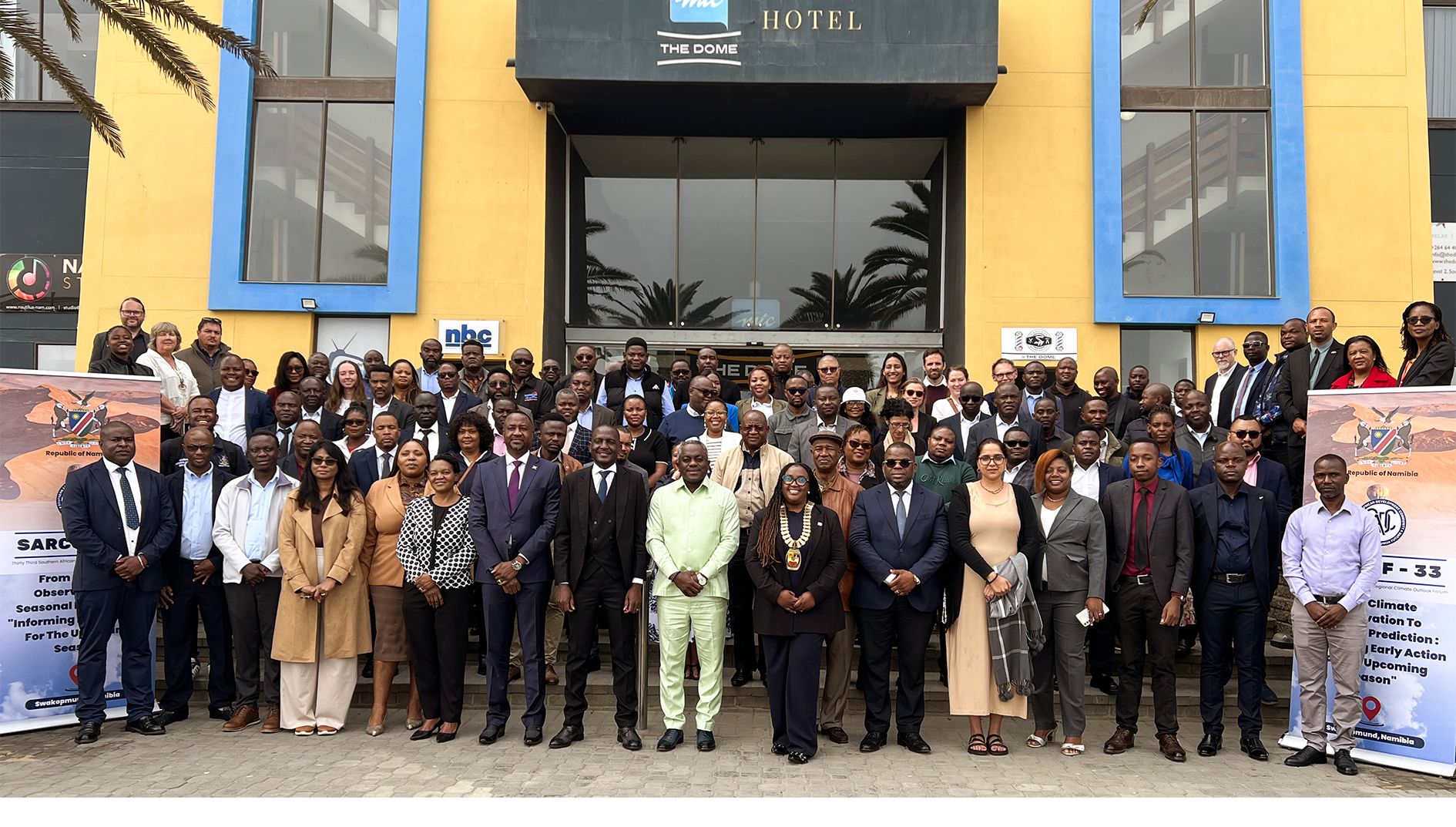
The Southern African Development Community (SADC), with the support of the Republic of Namibia, hosted the Thirty-Third Southern Africa Climate Outlook Forum (SARCOF-33) in Swakopmund, Namibia, from 25 to 28 August 2026, bringing together climate experts, National Meteorological and Hydrological Services, sector specialists, development partners and users of climate information from across the region.
Held under the theme, "From Climate Observation to Seasonal Prediction: Informing Early Action for the Upcoming Season," SARCOF 33 underscored the importance of moving beyond the production of climate information to ensuring that it informs preparedness, early warning, planning and timely action. The Forum also drew inspiration from the World Meteorological Day 2026 theme, "Observing Today, Protecting Tomorrow."
The Forum set a strong tone for enhanced regional preparedness, with Member States calling for greater investment in meteorological services, stronger regional cooperation and the effective use of climate information to protect lives and livelihoods, safeguard infrastructure and strengthen resilience to climate-related hazards.
In his keynote address, Hononurable Veikko Nekundi, Minister of Works and Transport of the Republic of Namibia, emphasised that investment in meteorology and multi-hazard early warning systems is an investment in human security and development. He called on SADC Member States to ensure that National Meteorological and Hydrological Services are adequately supported and equipped to provide timely and reliable information that can protect communities from climate-related risks.
Reflecting on the region's experience with droughts, El Niño and devastating tropical cyclones, including Cyclone Idai, Minister Nekundi stressed that climate change is already affecting communities and economies. He called for a fundamental shift "from reaction to prevention, from response to readiness, and from recovery to resilience," urging Member States to translate regional commitments into concrete resources and action.
He further called for stronger observation networks and greater integration of meteorological, hydrological and disaster management systems, stressing that weather stations, satellites, radars, buoys and data networks are necessities, not luxuries. He also urged the region to strengthen cooperation and continuously improve climate prediction so that forecasts generated lead to meaningful preparedness and early action.
Her Worship Councillor Suama Kautondokwa, Mayor of Swakopmund, highlighted the importance of ensuring that climate information reaches beyond the scientific community to governments, communities, businesses and other decision-makers. She encouraged participants to use the Forum to share knowledge and experiences and strengthen regional cooperation to ensure that climate information is accessible, understandable and useful to those who need it.
Ms. Rauna Mukumangeni, Director of Infrastructure at SADC Secretariat, emphasised the strategic value of climate information in supporting development and investment decisions. She noted that reliable weather and climate forecasts enable governments and other stakeholders to anticipate risks, protect lives and livelihoods, safeguard critical infrastructure and make better-informed investments.
Ms. Mukumangeni stressed the importance of strengthening the entire climate information value chain - from observation and data collection to forecasting, communication, decision-making and early action. She also highlighted the need for regional coordination, timely information sharing and cross-border early warning, noting that climate risks do not respect national boundaries and can affect shared infrastructure, transport corridors, energy systems, water resources and communities across countries.
Mr Jonas Sheelongo, Executive Director in the Ministry of Works and Transport of the Republic of Namibia, emphasised the responsibility of climate experts to continuously strengthen the accuracy and reliability of seasonal predictions. He noted that timely and credible forecasts are essential to prepare adequately for potential climate risks. He called for sustained technical efforts, greater sharing of expertise and information, and stronger collaboration among SADC Member States to collectively improve climate prediction and ensure that forecasts translate into effective preparedness.
The forum provided an opportunity to review the 2025/26 rainfall season, including the performance of the October-December 2025 and January-March 2026 rainfall periods, the impacts of El Niño and the climate drivers that influenced the season. Participants also assessed the current state of global climate drivers and their potential influence on the 2026/27 season.
Through sector-focused sessions, stakeholders from agriculture, food security and livestock, water, energy, disaster risk management, early warning, health and the private sector examined the implications of the climate outlook and identified appropriate preparedness, mitigation and anticipatory measures.
SARCOF-33 also featured a demonstration of the SADC Hazards Watch, providing participants with an opportunity to explore its application in monitoring and communicating weather and climate hazards. A SADC Hazards Watch Review Meeting was held on 28th August 2026, on the margins of the Forum to further strengthen the platform and its contribution to regional early warning.
The outcomes of the discussions will contribute to the Early Warning Advisory Note, providing practical guidance to policymakers, decision-makers and climate-sensitive. The Forum culminated in the release of the SARCOF-33 Official Summary Statement and the Regional Seasonal Climate Forecast for the season ending March 2027, providing an important basis for preparedness, planning and early action across the SADC region.
Through SARCOF, SADC continues to strengthen the link between climate science, policy investment and action, advancing a regional approach in which better observations and more reliable predictions translate into timely decisions, stronger preparedness and a more resilient, climate-smart Southern Africa.
The full Statement is attached below
| Attachment | Size |
|---|---|
| EN_FINAL SARCOF-33 STATEMENT-final-28Aug1600hrs_0.pdf (2.38 MB) | 2.38 MB |
| PRESS RELEASE SARCOF-33-27 Aug.pdf (119.17 KB) | 119.17 KB |


